2020 FIS Mainau Manifesto
International Ski Federation
Details

In 1994, the first FIS Mainau Manifesto was unanimously approved by the FIS Congress. This was a pioneering commitment to the responsibility of snow sports towards nature and sustainability. The Manifesto was motivated by the 1992 UN Conference on Environment and Development.


This Friday, 5th June is World Environment Day, which provides the perfect opportunity to formally share the newly-updated Mainau Manifesto, which was approved by the […]

Regular physical activity of moderate intensity – such as walking, cycling, or doing sports – has significant benefits for health. At all ages, the benefits of being physically active outweigh potential harm, for example through accidents. Some physical activity is better than none. By becoming more active throughout the day in relatively simple ways, people can quite easily achieve the recommended activity levels.
The mobility needs of people who walk and cycle – often the majority of citizens in a city – continue to be overlooked, states Share the Road Programme Annual Report 2018, even though the benefits of investing in pedestrians and cyclists can save lives, help protect the environment and support poverty reduction. Meeting the needs of people who walk and cycle continues to be a critical part of the mobility solution for helping cities de-couple population growth from increased emissions, and to improve air quality and road safety.

This module is part of a 12 clips guide created by SportAccord, AISTS, PI, and IOC, to help us understand sustainability as a whole, and look at what it means. This module starts with why we should measure the impact of a sport event and its importance, and the different stages of an event when it makes an impact. It introduces the key points of the following types of impact (economic, social and environment), data gathering and cost issues. (Video 7/12)




FIFA, the Supreme Committee for Delivery & Legacy (SC) and the FIFA World Cup Qatar 2022 LLC have received special recognition from Qatar Green […]

In the 21st Century, more and more businesses, organizations and individuals are building sustainability into their day- to-day decision making. Understanding how we do business is as important to today’s customer as what we do. There are a growing number of golf facilities that have found ‘being more sustainable’ meant doing things simpler, better and faster. The Sustainable Golf Development Voluntary Sustainability Standard (VSS) provides a framework for the effective integration of sustainability into the design and construction processes for golf projects.
The Well-being of Future Generations (Wales) Act seeks to achieve a globally significant set of national goals that would make Wales one of the most sustainable societies in the world. Although the legislation applies to named public bodies, as an organisation that receives public money and takes its obligations to society very seriously, we (Glamorgan County Cricket Club) voluntarily commit to these goals.

The CDP (formerly the Carbon Disclosure Project) is an organisation based in the United Kingdom which supports companies and cities to disclose the environmental impact of major corporations.
It aims to make environmental reporting and risk management a business norm, and drive disclosure, insight and action towards a sustainable economy.
Since 2002 over 8,400 companies have publicly disclosed environmental information through CDP.
CDP piggybacked on GRI's concept of environmental disclosure in 2002, focusing on individual companies rather than on nations.
At the time CDP had just 35 investors signing its request for climate information and 245 companies responding.
Today, nearly a fifth of global greenhouse gas emissions are reported through CDP
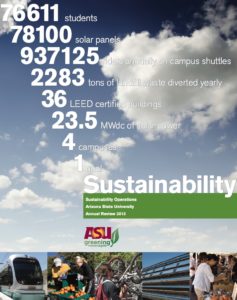
Annual Report (2013) of Arizona State University taking measurable steps to reduce consumption, maximize efficiency and to rethink products and processes by focusing on four key areas: climate neutrality; zero solid and water waste; active engagement; and principled practice.
World Sailing’s Sustainability Agenda 2030 sets out a bold ambition to achieve substantial change within the sport which can contribute actively to global sustainability. Sustainability Agenda 2030 is supported by World Sailing’s vision and mission which was launched in October 2016.