The International Union for Conservation of Nature (IUCN) is a membership Union uniquely composed of both government and civil society organisations. It provides public, private and non-governmental organisations with the knowledge and tools that enable human progress, economic development and nature conservation to take place together.
Created in 1948, IUCN is now the world’s largest and most diverse environmental network, harnessing the knowledge, resources and reach of more than 1,300 Member organisations and some 15,000 experts. It is a leading provider of conservation data, assessments and analysis. Its broad membership enables IUCN to fill the role of incubator and trusted repository of best practices, tools and international standards.
IUCN provides a neutral space in which diverse stakeholders including governments, NGOs, scientists, businesses, local communities, indigenous peoples organisations and others can work together to forge and implement solutions to environmental challenges and achieve sustainable development.
Working with many partners and supporters, IUCN implements a large and diverse portfolio of conservation projects worldwide. Combining the latest science with the traditional knowledge of local communities, these projects work to reverse habitat loss, restore ecosystems and improve people’s well-being.
What’s biodiversity?
Biological diversity, or biodiversity in short, is defined by the Convention on Biological Diversity as the ‘.. variability among living organisms from all sources including, inter alia, terrestrial, marine, and other aquatic ecosystems and the ecological complexes of which they are a part; this includes diversity within species, between species, and of ecosystems’. Biodiversity supports valuable ecosystem services that are essential for the survival and healthy functioning of human society and its economic activities.
The links between Sport and Biodiversity
Sport can have significant negative impacts on biodiversity, through the construction and use of sports venues and the staging of sporting events. Sport can negatively impact biodiversity through land use to build permanent or temporary sports venues and facilities, as well as through the pollution, noise, waste, lighting, traffic, and resource demand resulting from the staging of sporting events attended by hundreds or thousands of spectators. At the same time, sport, through its global reach, can be an important catalyst for raising awareness about the need for biodiversity conservation, and promoting and supporting efforts to enhance biodiversity.
Understanding and managing the potential negative impacts and opportunities for conservation is vital for ensuring that sports venues and sporting events deliver successfully both from the financial and operational standpoint. Unmanaged or poorly managed biodiversity impacts can lead to financial, regulatory, operational, and reputational risks. On the other hand, timely and effective action to mitigate risks and enhance conservation can help venues and event planners and organisers increase their social license to operate, more easily attract future sporting events, establish long-term positive relationships with communities and the media, and attract sponsors.
Mitigating negative impacts on biodiversity
The construction of new sports venues, the installation of temporary venues and associated facilities, and the use and refurbishment of existing venues can all impact on biodiversity. The type of risks and opportunities will vary, depending mainly on the location of the venue (i.e. whether it is sited in an urban area or in the natural environment, and the importance of that environment for biodiversity) and on its size. While the impacts may be broader, more severe, and more obvious in a natural, undeveloped area, where it is often necessary to construct access roads, power supply infrastructure, and water and sewer infrastructure (amongst others), there are also risks to developing in urban areas, where many species make their homes within the built environment.
The staging of sporting events in both urban and natural settings can impact biodiversity through the presence of large numbers of spectators, who increase noise, vibration, pollution, waste generation, and traffic. Other risks to biodiversity from sporting events include oil or fuel spills, sewage discharge, light pollution, increased use of chemicals and fertilisers, and increased demand for natural resources.
To address these potential impacts, developers should first comply with all legal and statutory requirements relating to biodiversity. Beyond compliance, the recommended way to manage biodiversity impacts effectively is through the mitigation hierarchy of avoidance, minimisation, restoration, and offsetting of residual impacts. Preventive mitigation measures (avoidance and minimisation) are always preferable to corrective measures (restoration and offsets).
Maximising opportunities for biodiversity conservation
Sporting events and their associated facilities can leverage opportunities to promote and support biodiversity conservation through a variety of activities and initiatives, including:
• enhancing natural habitats in urban environments by restoring degraded sites, connecting fragmented habitats, building ‘green’ rooftops and living walls, installing man-made habitats for wildlife, increasing the diversity of plant species, and incorporating plantings in their project design that provide additional habitat and benefits to local fauna and flora;
• increasing the area under protection through on-site or off-site protection of natural features;
• generating funds and increasing awareness for protected area management by staging low-impact sporting events, such as running or mountain biking, within or partially within protected areas;
• raising public awareness about biodiversity through the use of biodiversity elements as mascots or as part of an event’s logo, and the creation of public exhibits and educational programs, as well as through sports commentators and individual, high-profile athletes;
• increasing available knowledge and data by sharing biodiversity inventories and baseline information that may be required as part of venue development with conservation organisations and research institutions; and
• generating biodiversity benefits through projects designed to offset the carbon footprint of a venue or event.
Where can you find solutions?
IUCN, in collaboration with IOC, has developed a series of guides designed to help decision makers understand and manage these potential impacts, as well as for maximising opportunities to use sport as a way to promote and enhance biodiversity conservation.
Read more about the Guides: Sport and Biodiversity published by IUCN (International Union for Conservation of Nature) in 2018
- Sport and biodiversity in 2018
- Mitigating biodiversity impacts of new sports venues - published by IUCN (International Union for Conservation of Nature) in 2019
- Mitigating biodiversity impacts of sports events - published by IUCN (International Union for Conservation of Nature) in 2020
Location: Gland - Switzerland



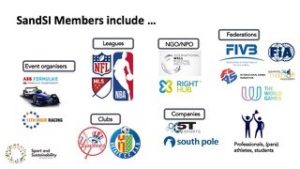
Sport and Sustainability International (SandSI) is a non-profit Swiss association that seeks to accelerate sustainability in and through sport. SandSI is a global membership organisation, bringing together both sport and non-sport entities as well as athletes and scholars from all continents, using one common language: sport. Through its programmes, SandSI strives to have a positive impact on climate, waste and health, aligning itself with the UN Sustainable Development Goals. The 2030 SandSI Goals are:
- Climate: the sport sector to become carbon neutral by 2030
- Waste: the sport sector to become zero waste by 2030
- Health: the sport sector to contribute to 15% reduction on physical inactivity by 2030
- 1. Football4Climate: a multi-year programme with and for the football industry to addresses its impact and leverages the cultural and market influence of football to promote climate action
- 2. SDG Sport Lab: a creative platform to initiate, encourage and support concrete initiatives that use sport to contribute to the United Nations Sustainable Development Goals
Location: - Switzerland




March 30, 2021
News / Interviews
Making Earth-Friendly Football a Reality
Sustainability in sports still has a long way to go, but there is one place that is revolutionising the notion of becoming an “earth-friendly […]
Organiser:
Green Sport Alliance
Green Sport Alliance
Setting the Tone: Leading Sustainability Commitments Across the Sports Industry
Teams, leagues, and corporate entities continue to expand their goals and aspirations regarding zero waste, carbon neutrality, renewable energy and more. Join our GSA network as we discuss the history of these undertakings, the level of planning and execution that goes into these commitments, and how they are leveraging their organizations and partners to ultimately achieve their goals.
Speakers:
Isabella Bertold | Founder and Co-owner, La Prima Professional Cycling & Sustainability Entrepreneur
Samantha Foster | Managing Director, University of Southern California (USC) Endowment
Lee Spivak | Managing Principal of Sports and Entertainment, WM Sustainability Services
Moderator:
Garrett Wong | Member Services Manager, Green Sports Alliance
Date: Wednesday, March 31st
Time: 10:00am PT/1:00pm ET
Registration link : https://register.gotowebinar.com/register/4145860738724370445

he Youth Charter is a UK registered charity and UN accredited non-governmental organisation. Launched in 1993 as part of the Manchester 2000 Olympic Bid and the 2002 Commonwealth Games, the Youth Charter has Campaigned and Promoted the role and value of sport, art, culture and digital technology in the lives of disaffected young people from disadvantaged communities nationally and internationally. The Youth Charter has a proven track record in the creation and delivery of social and human development programmes with the overall aim of providing young people with an opportunity to develop in life.
Specifically, the Youth Charter tackles educational non-attainment, health inequality, anti-social behaviour and the negative effects of crime, drugs, gang related activity and racism by applying the ethics of sporting and artistic excellence. These can then be translated to provide social and economic benefits of citizenship, rights responsibilities, with improved education, health, social order, environment and college, university, employment and enterprise.
The Youth Charter acts as a social broker and cultural interface between public/private sector and donor organisations. The key to the Youth Charter approach is to provide capacity, leadership and self reliance to hard to reach young people and their communities. This is delivered through our Social Coach training and development workshops, programmes and projects. Further assistance, campaigning, advocacy, support and advice is delivered through our ‘on-line’ distance learning and evaluation tools, which provide a unique impact and assessment of each individual’s and community’s ongoing development and progress.
Supported by over 250 Global Sporting, Artistic and Cultural Ambassadors and high profile social role models, the Youth Charter is pioneering new approaches to tackling the increasingly serious problem of anti-social behaviour amongst socially excluded youth.
Location: - United Kingdom contact@youthcharter.org
Since the public release of The Game Changers (TGC) in the fall of 2019, an estimated 75M people in more than 190 countries have viewed the documentary on various platforms, including iTunes, Netflix, and Youku.
In addition to TGC’s mainstream success, the film’s scientific credibility has resulted in recognition from the American College of Lifestyle Medicine, the Academy of Nutrition and Dietetics, and the Defense Health Agency, as well as an endorsement from the Special Operations Medical Association.
In response to the success of film and the support it generated, the Game Changers Institute (GCI) — an initiative of the Game Changers Foundation, a non-profit public charity based in the Unites States of America — was launched early 2021 in order to help unite the performance, health, social justice, and environmental spaces under a single authoritative banner with the integrity and diversity to reach a global audience about the critical importance of a plant-centered diet.
Location: - United States of America

March 26, 2021
News / Interviews
Sustainability a ‘top priority’ for sponsorship activations
Samantha Lamberti of Nielsen Sports reflects on brands’ increasing preference to line up with sports properties that can support their environmental and social goals […]
Source: The Sustainability Report

EduSport (Education through Sport) is a community driven NGO founded in 1999 in response to identified gaps in opportunities for communities to participate in sport and for youth empowerment.
Edusport’s aim is integrating Sport into the Development process through its programmes. It combines sports and life skills training especially to socio-economically under served and at risk young people.
Edusport is found in 9 of 10 provinces of Zambia. It is currently operating in over 84 under served communities in 21 districts around Zambia. The organisation targets youths, trains them to become peer leaders, local role models and community mobilizers to drive change and spread the message of hope.
Go Sisters! programme
Go Sisters! is a programme launched in 2001 in Lusaka, Zambia to empower girls through Sport concept. It’s meant to allow girls to play, learn, exercise leadership roles, develop, discus, and have that space which is usually taken away from them. The programme is run by Girls for girls with girls. They also try incorporate boys so a way of raising a generation that will appreciate and respect each other.
Location: - Zambia info@edusport.org.zm

Founded by Matthew Spacie in 1999, Magic Bus equips children and young people in the age group of 12 to 18, with the skills and knowledge they need, to grow up and move out of poverty.
This takes them from a childhood full of challenges to a life with meaningful livelihoods. Since its inception, Magic Bus has transformed the lives of one million children and young people, helping them move out of poverty.
Magic Bus developed a life skills programme that aims to connect underserved children to vocations through sport.
Location: - Mumbai, India info@magicbusindia.org

United Through Sports is an alliance of many organisations working together through sports to bring unity and peace to an often-divided world. UTS is actively supported by the IOC, GAISF SportAccord and AIMS for the trust granted to us in coordinating this much needed initiative.
United Through Sports brought world renowned personnel to one round table in 2018 at the inauguration of UTS during the SportAccord Convention in Bangkok. The opening conference showed the importance of working together as one and the three day festival is an affirmation of our youth looking to us not only for guidance but reminding us all about our duties and the impact our decisions have on their future.
Location: admin@unitedthroughsports.com