
Funded and supported by the German governmental, academic and non-profit sectors, the German Olympic Sports Confederation (DOSB) has developed Green Champions 2.0, a bilingual (German and English), step-by-step online sustainability tool for sports event organisers such as National Federations (NFs) and local organising committees (LOCs).



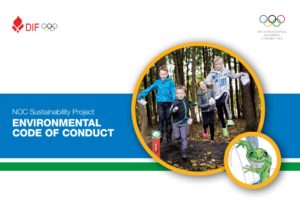
Originally drafted in 1997 and revised in 2008, the National Olympic Committee and Sports Confederation of Denmark (DIF)’s Environmental Code of Conduct contains requirements and recommendations on the subjects of nature, the direct and action-oriented language of the code has been designed to strongly encourage its implementation.

The Spanish Olympic Committee (COE) has developed a Sustainability Strategy that is aligned with the IOC Sustainability Strategy, Olympic Agenda 2020 and the United Nations’ (UN) Sustainable Development Goals. The strategy is designed to be a benchmark for sustainability in Spanish sport and the wider Olympic Movement.

In May 2019, World Taekwondo (WT) launched its first Sustainability Strategy. Containing 17 recommendations designed to ensure WT, its continental unions and member national associations are operating sustainably, the strategy is directly aligned with the International Olympic Committee (IOC) Sustainability Strategy It was presented by the WT Sustainability Committee at the World Taekwondo Conference, and was subsequently approved by both the WT Council and General Assembly.

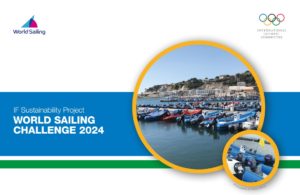
On 4 July 2019 at the Monaco Solar & Energy Boat Challenge, World Sailing launched its ambitious Challenge 2024 initiative – pushing the boundaries of low-carbon innovation for support boats presence at international events. Challenge 2024 has been partly inspired by World Sailing signing up to United Nations (UN) Climate Change’s Sports for Climate Action framework in December 2018, and is directly aligned with World Sailing’s Sustainability Agenda 2030 targets.

In 2018, World Sailing teamed up with 11th Hour Racing, an organisation that promotes collaborative and systematic change to benefit the health of the oceans, World Sailing created a sustainability award in order to: Support the implementation of World Sailing’s Sustainability Agenda 2030. Call for innovation across the sailing community to help tackle environmental challenges. Raise awareness about sustainability and inspire the sport community to take similar actions. Give profile and financial support to organisations that are delivering replicable sustainability initiatives Launch a new sustainability award With a sponsor secured for an initial period of three years, the project calls on the sailing community to develop and implement innovative sustainability-oriented projects, and rewards the annual winner with a prize of USD10,000 to help them further develop the initiative.

United World Wrestling (UWW) understands that engaging youth is fundamental to the long-term sustainability of wrestling development, and the More than Medals programme, launched in 2016, supports this. The programme includes training camps where dedicated educational sessions cover numerous topics including the importance of climate change. The series of camps target young athletes and their coaches/entourages using a holistic approach. Participants practise wrestling while receiving education on climate action with an emphasis on “participation, distinction and diversity”. In 2019, the UWW joined the United Nations Framework Convention on Climate Change (UNFCCC) Sports for Climate Action Framework alongside the IOC. As part of the activation, the UWW is now developing and implementing an even stronger educational aspect within the More than Medals programme to include UWW members. The aim of the programme is to: Undertake systematic efforts to promote greater environmental responsibility. Reduce overall climate impact. Offer education on climate action. Promote sustainable and responsible consumption. Advocate for climate action through communication.
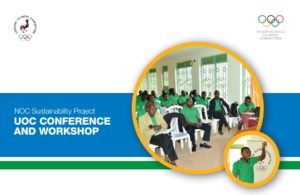
In August 2018, the National Olympic Committee of Uganda (UOC) held a national sustainability conference and training workshop on sustainable sport in Kampala, with the help of Olympic Solidarity. Having acknowledged a lack of environmental responsibility within the Ugandan sports community, the UOC wanted to address concerns about the impact that sport can have on the environment, individuals and the public, as well as the impact a degraded environment can have on sport.
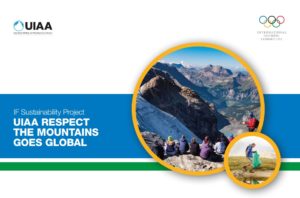
The International Climbing and Mountaineering Federation (UIAA)'s Respect the Mountains (RTM) is an initiative launched in 2015 that encourages UIAA stakeholders to combine a clean-up operation with an education and awareness programme implemented at their events.
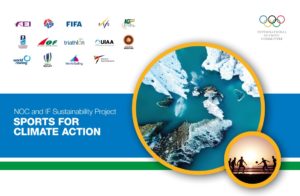
In December 2018, the United Nations Framework Convention on Climate Change (UNFCCC) and the International Olympic Committee (IOC) co-launched the new Sports for Climate Action Framework and defined the role of sport in the worldwide fight for climate change. The UN Sports for Climate Action Framework aims to help sports organisations reduce emissions caused by their operations and leverage the worldwide popularity of sport to engage millions of fans in the effort.