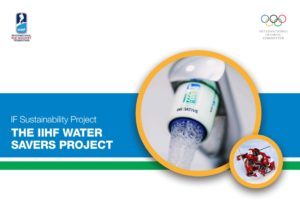
In 2013, the International Ice Hockey Federation (IIHF) Social & Environment Committee launched its first water savers distribution project. The programme consisted of issuing small packages containing three simple devices that are attached to faucets in order to significantly reduce water consumption. The project formed part of an overall effort by the committee to respond to the desire of its members to take a more sustainable approach in daily activities. The IIHF commissioned Adcom, a Swiss marketing company, to create customised water savers.
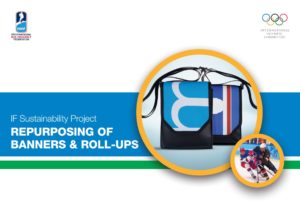
The International Ice Hockey Federation (IIHF) began its banner repurposing project after the annual General Congress in 2012. Members agreed that the roll-ups created for the event carried a significant cost and should be reused in a creative way rather than simply being disposed of. The idea of reusing materials had previously been raised during meetings of the IIHF Social & Environment Committee, and members considered Congress to be the perfect opportunity to kick-start the repurposing programme.

In 2013, the International Canoe Federation (ICF) was approached by Paddle for the Planet (P4P), a registered NGO that unites paddlers and watermen for conservation, about the possibility of forming a partnership. P4P’s signature event is the annual Global Paddling Relay: simultaneous paddling events that start sequentially, on the same day and at the same time, in different time zones all over the world, thereby creating a global relay. Paddlers of any type of paddling craft (rowing boats, dragon boats, canoes, kayaks and others) are united through the event.
Since 2008, the International Biathlon Union (IBU) has received approximately 100 competition packages every two years for its international referees and technical delegates through its partnerships with suppliers. The uniform packages include boots, winter jackets, tops, trousers and raincoats, ensuring officials are correctly clothed for the winter weather conditions during competition and are easily recognisable as IBU officials. When new sets of uniforms are dispatched, the IBU asks officials to return their previous sets. This request is designed to ensure that there is no confusion regarding which set is currently valid for use. Approximately 80 of these used uniforms are then sent to a local partner company for repairs and to remove the IBU officials logo, at a total cost every two years of approximately €12,000.
The International Bobsleigh & Skeleton Federation (IBSF) regularised a number of new policies relating to travel and transportation within the federation. The policies were created as a strategic response to the high travel costs that had been observed in the 2010 annual financial report. Previously, the more than 90 jury staff assigned to competitions, the IBSF Executive Board and the IBSF staff members could organise their own travel to competitions and other events, and then be reimbursed by the IBSF. The new approach centralises all travel arrangements, with a specific employee dedicating part of her time to arranging transportation in the most efficient and sustainable way possible.
The International Bobsleigh & Skeleton Federation (IBSF) believes that an energised and motivated staff will result in productive and efficient ways of working. The goals of this “Family Comes First” approach have been to increase the morale of IBSF staff members, to keep them motivated about their jobs, and to create a positive work environment. For example: Short, informal meetings with all employees are held for 10-15 minutes each day, allowing members of staff to chat about non-work-related topics.
As part of FIS Green, the FIS’s comprehensive new sustainability strategy due to be launched in early 2017, the FIS decided to create a database of sustainability initiatives implemented by ski resorts across the globe. The database features projects conducted by more than 700 ski resorts, which were selected from the existing database of resort information available to the FIS. A total budget of 5,000 CHF was allocated to the project. The information was compiled through online desk research from the websites of the ski resorts. This method was specifically chosen as the FIS preferred to focus on information that was already publicly available, which confirmed that the ski resorts had sought to communicate their initiatives. The collected information has been divided into four focus areas: alternative methods of energy; recycling practices; alternative methods of transport in the resort; and existing partnerships with public transportation.


New hockey fields are major investments, and it is important they meet the expectations of players, clubs and associations. To help ensure excellent fields for all levels of play, the International Hockey Federation (FIH) launched its Quality Programme for Hockey Turf in October 2015 as part of Hockey Revolution, its ten-year strategic vision for the sport. The programme certifies suppliers, manufacturers, field builders and hockey turfs based on their compliance with a set of criteria, which include the use of sustainable best practices, staff experience, weather resistance and raw materials. The programme also offers certification for hockey fields through FIH Accredited Test Institutes, which meet the FIH’s international standards and are evaluated regularly.

Highlighting its commitment to sustainability, FIFA made the decision in 2009 to include it in its future bidding agreements, starting with the 2018 FWC bidding process. This required each bidding country to provide comprehensive information on activities aimed at social development, economic sustainability and environmental protection as part of the staging of the FWC. In December 2010, the Russian Federation was selected to host the 2018 FWC. Then, in late 2013, FIFA began working with the LOC to create a sustainability strategy for the event. The 2018 FWC in Russia was planned in close connection with long-term national development strategies and programmes, with the ultimate goals of creating social, environmental and economic benefits for host cities and regions and creating a new standard for large events within the country.


Despite increasing environmental awareness among citizens, no fully-fledged system of separate waste collection currently exists in Russia. It is said that waste disposal sites in Russia currently occupy around 30,000 square miles, and waste processing facilities in Moscow are close to full capacity. It has become increasingly important for Russia to take action in addressing and solving its waste management problem. As part of FIFA’s sustainability initiatives for the 2018 FIFA World Cup in Russia, approximately 20 percent of all waste collected during the hosting of the Preliminary Draw in Saint Petersburg was recycled through a system put in place by the LOC. The project was part of the Sustainability Strategy developed by FIFA and the LOC.